As we all may know, the First Lemurian Clothing Taxonomy (LCT-01) has been running for a long while. If you're new to it, read the primer, as it will help.
Picniflava will hopefully be a good way to get to posting about this taxonomy; after all, it was covered in the primer alongside its sister genus Georgetta, and its family, Amidalidae.
Padmé and her dresses
Padmé Amidala is a character from the franchise Star Wars. She has an extensive wardrobe of clothing that costumers and cosplayers have replicated. One of the sites I consulted during my early research into Amidala's dresses is the Padawan's Guide, a website operated by Maggie that has been up since the early 2000s. Unfortunately, it does not have HTTPS, so visit at your own risk. (It's really not that hard to use Let's Encrypt!)
The Padawan's Guide lists 38 costumes; already, we have a lot of genera on our hands. Because of the high-level structure of the LCT-01, only three of these costumes have been classified; the yellow picnic dress (Picniflava), the aqua georgette dress (Georgetta), and the corset gown (Aminicotta). All of these three genera fall in the class Umerostentida (Latin for "shoulder exposer").
Picniflava is also known as the summer meadow dress on Wookieepedia.
- Class Umerostentida
- Subclass Unilourida
- Order Capistriformes
- Family Capimelasidae
- Genus Aminicotta
- Family Capimelasidae
- Order Capistriformes
- Subclass Bilourida
- Order Biligamentum
- Family Amidalidae
- Genus Picniflava
- Species P. chattanoogensis
- Genus Georgetta
- Genus Picniflava
- Family Amidalidae
- Order Biligamentum
- Subclass Unilourida
In this article, we are focusing on Picniflava. The name comes from English picnic and Latin flava 'yellow'. Picniflava is the largest genus in the LCT-01, with 58 species (this includes P. chattanoogensis) and counting. The earliest known species of Picniflava is P. originalis, the type species. It is the original dress from which all replicas were made. It appears in Star Wars: Episode II – Attack of the Clones (2002), where Anakin Skywalker and Amidala have a moment together on a field on Naboo. P. originalis, also numbered P-19, was created by the costume designer Trisha Biggar and her department.
Morphologically, Picniflava is an off-shoulder dress with bilateral single straps (one strap on each side), with two roses; one ventrally (front) and another one dorsally (back). These straps are attached to a corset, which features the same roses and other floral decorations. On the sleeves, white, pink, and blue ribbons hang off the distal end (near the wrist), wrapping 2–3 times around the underlying bodice, which gathers where the ribbons are tied. Some Picniflava spp. (species, plural) feature green ribbons; an image of P. originalis features a vaguely green one. Amongst the 58 species, lighting conditions differ. Amongst readers like you, monitors differ, increasing the uncertainty further.
The bodice features a shawl at the top, made of netting with a vine pattern and clusters of three roses each. Positioned medially (in the center) along the neckline is a pin, known as the brooch. It is about 2.5 cm (1 in) long. It is a tiny Deco butterfly, though Maggie of the Padawan's Guide writes that the wings look more like a dragonfly.
The skirt, which terminates at the ankle-level (maxi-length), consists of two layers; an outer gold-colored layer with small four-petal sequins. They appear white in images, but Maggie of the Padawan's Guide believes them to be a "pale champagne gold" or "pearlescent silvery color".
On the head, the costume features a bilateral bun (one bun on each side of the head) and a green headband. Dorsally (at the back), the wearer's hair is then tied together with more ribbons. These ribbons are not attached to the ones at the sleeve.
Now that you've digested that incomprehensible textwall of taxonomic, medical, and fashion terminology, let's get to the species nova (meaning "new species"; abbreviated sp. nov.).
P. chattanoogensis sp. nov.
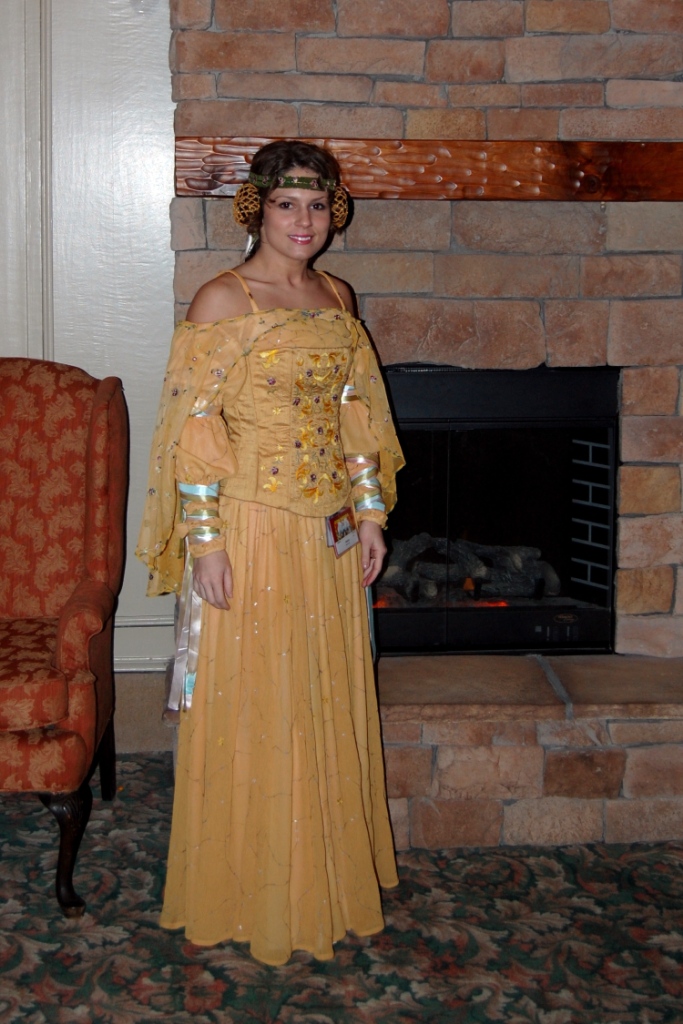 Picniflava chattanoogensis sp. nov.; wb. unknown, 2008
Picniflava chattanoogensis was photographed by Sparr Risher on October 21, 2008, at the Con Nooga event in Chattanooga, Tennessee, US. Its wearer was wearing a nametag, but the resolution of Risher's photo is too low for it to be visible. There is also no name on the image, which meant the only option was to name the dress after where it was worn; Chattanooga. Thus, the dress shall have the species epithet chattanoogensis, from Chattanooga + Latin -ensis (a prefix used in many other binomial names to indicate where something was found).
The citation form for P. chattanoogensis in full will now be:
Picniflava chattanoogensis Lemuria, 2026
Possible synonymy?
By paying very close attention to the placement of roses and that badge, it is possible that the dress may be similar to another species, P. jessicae. 1, worn by Jessica. Pay close attention to the roses on the shawl; there is a rose on her left (which would be on the right of the image), in both images.
However, I'm not convinced yet, so for now, P. chattanoogensis is a separate species until I take a much closer look. Taxonomy can sometimes be a game of spot the difference, which makes it fun, perhaps?
Conclusion
You made it to the end. I'm not sure how else to write a conclusion, but I can say that the LCT-01 will keep going. We may not ever build a full tree of human clothing, but we're going to try anyway, and we're going to have a lot of fun.
If you'd like to talk about the LCT-01, join our Matrix room at #lct01:matrix.org. I yap about the taxonomy there occasionally. Thanks for reading!
Copyright
The image of P. chattanoogensis is copyright © Sparr Risher (sparr0), who released it on Flickr under CC BY-SA 2.0 "Generic".
Star Wars is © Lucasfilm, Ltd. or their creators, however I have not used any of their images in this blog post. Nobody reads this legalese anyway.