This is a project that's been in the works since September 2025, when one day I got bored and started giving dresses Latin names, and now I know way too much about taxonomy. Not only that, my level of fashion knowledge now far exceeds the stereotypical gender role-based recommended amount for a heterosexual cisgender male.
Today I decided to make an infographic to act as a primer for the LCT-01. I cannot publish the entire taxonomy yet, as it is on my personal wiki which is so closely intertwined with the rest of my personal life, and I don't have a datacenter, or the server and disk space to do so. Plus, there's also going to be a lot of work writing emails to get both legal copyright permission and moral consent. (If you would like your photo removed from the taxonomy, a polite email may help.)
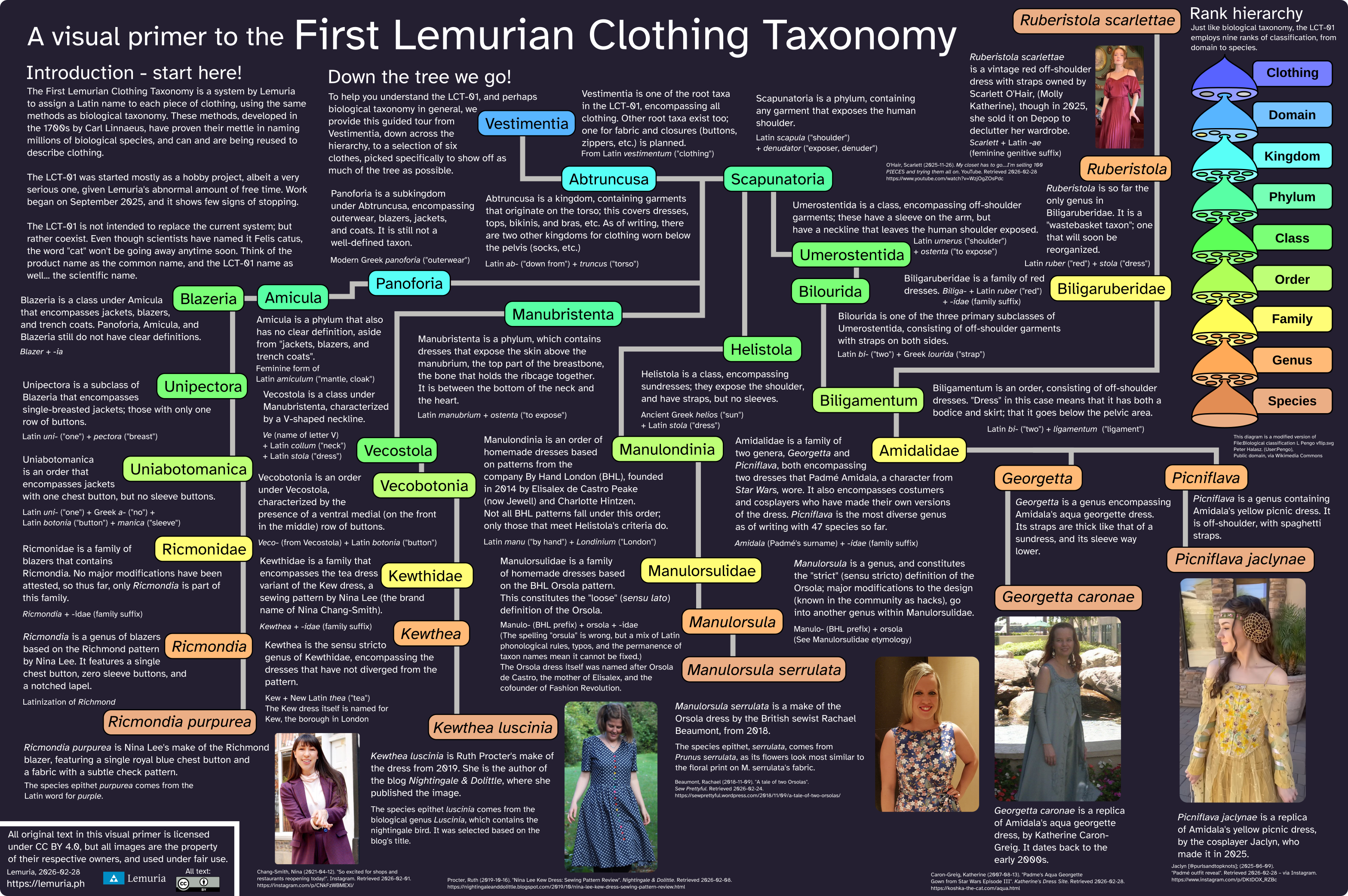
- Full-size image: https://static.lemuria.ph/lct01primer.png
- Download the original SVG: https://static.lemuria.ph/lct01primer.svg
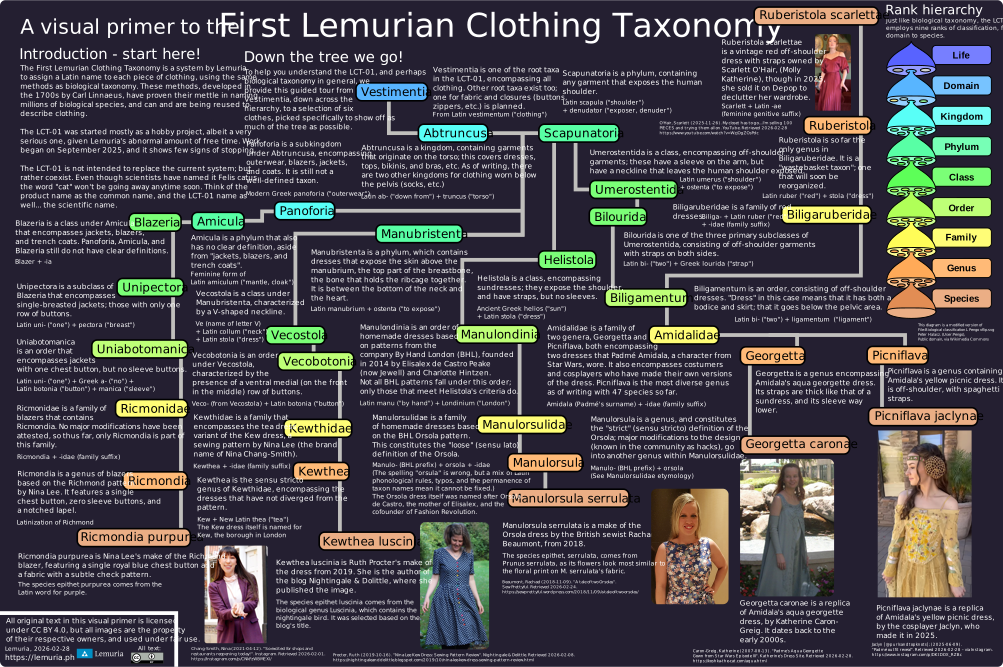
Text version
Not everyone has blazing fast internet, so enjoy this text version while waiting for it to load.
Introduction - start here!
The First Lemurian Clothing Taxonomy is a system by Lemuria to assign a Latin name to each piece of clothing, using the same methods as biological taxonomy. These methods, developed in the 1700s by Carl Linnaeus, have proven their mettle in naming millions of biological species, and can and are being reused to describe clothing.
The LCT-01 was started mostly as a hobby project, albeit a very serious one, given Lemuria's abnormal amount of free time. Work began on September 2025, and it shows few signs of stopping.
The LCT-01 is not intended to replace the current system; but rather coexist. Even though scientists have named it Felis catus, the word "cat" won't be going away anytime soon. Think of the product name as the common name, and the LCT-01 name as well... the scientific name.
Down the tree we go!
To help you understand the LCT-01, and perhaps biological taxonomy in general, we provide this guided tour from Vestimentia, down across the hierarchy, to a selection of six clothes, picked specifically to show off as much of the tree as possible.
Vestimentia
Vestimentia is one of the root taxa in the LCT-01, encompassing all clothing. Other root taxa exist too; one for fabric and closures (buttons, zippers, etc.) is planned.
From Latin vestimentum ("clothing")
Abtruncusa
Abtruncusa is a kingdom, containing garments that originate on the torso; this covers dresses, tops, bikinis, and bras, etc. As of writing, there are two other kingdoms for clothing worn below the pelvis (socks, etc.)
Latin ab- ("down from") + truncus ("torso")
Scapunatoria
Scapunatoria is a phylum, containing any garment that exposes the human shoulder. Latin scapula ("shoulder")+ denudator ("exposer, denuder")
Helistola
Helistola is a class, encompassing sundresses; they expose the shoulder, and have straps, but no sleeves. Ancient Greek helios ("sun")+ Latin stola ("dress")
Manulondinia
Manulondinia is an order of homemade dresses based on patterns from the company By Hand London (BHL), founded in 2014 by Elisalex de Castro Peake (now Jewell) and Charlotte Hintzen. Not all BHL patterns fall under this order; only those that meet Helistola's criteria do.
Latin manu ("by hand") + Londinium ("London")
Manulorsulidae
Manulorsulidae is a family of homemade dresses based on the BHL Orsola pattern. This constitutes the "loose" (sensu lato) definition of the Orsola.
Manulo- (BHL prefix) + orsola + -idae (The spelling "orsula" is wrong, but a mix of Latin phonological rules, typos, and the permanence of taxon names mean it cannot be fixed.) The Orsola dress itself was named after Orsola de Castro, the mother of Elisalex, and the cofounder of Fashion Revolution.
Manulorsula
Manulorsula is a genus, and constitutes the "strict" (sensu stricto) definition of the Orsola; major modifications to the design (known in the community as hacks), go into another genus within Manulorsulidae.
Manulo- (BHL prefix) + orsola (See Manulorsulidae etymology)
Manulorsula serrulata
Manulorsula serrulata is a make of the Orsola dress by the British sewist Rachael Beaumont, from 2018.
Manubristenta
Manubristenta is a phylum, which contains dresses that expose the skin above the manubrium, the top part of the breastbone, the bone that holds the ribcage together. It is between the bottom of the neck and the heart.
Latin manubrium + ostenta ("to expose")
Vecostola
Vecostola is a class under Manubristenta, characterized by a V-shaped neckline. Ve (name of letter V) + Latin collum ("neck") + Latin stola ("dress")
Vecobotonia
Vecobotonia is an order under Vecostola, characterized by the presence of a ventral medial (on the front in the middle) row of buttons. Veco- (from Vecostola) + Latin botonia ("button")
Kewthidae
Kewthidae is a family that encompasses the tea dress variant of the Kew dress, a sewing pattern by Nina Lee (the brand name of Nina Chang-Smith).
Kewthea + -idae (family suffix)
Kewthea
Kewthea is the sensu stricto genus of Kewthidae, encompassing the dresses that have not diverged from the pattern.
Kew + New Latin thea ("tea"). The Kew dress itself is named for Kew, the borough in London.
Kewthea luscinia
Kewthea luscinia is Ruth Procter's make of the dress from 2019. She is the author of the blog Nightingale & Dolittle, where she published the image. The species epithet luscinia comes from the biological genus Luscinia, which contains the nightingale bird. It was selected based on the blog's title.
The species epithet, serrulata, comes from Prunus serrulata, as its flowers look most similar to the floral print on M. serrulata's fabric.
Panoforia
Panoforia is a subkingdom under Abtruncusa, encompassing outerwear, blazers, jackets,and coats. It is still not a well-defined taxon.
Modern Greek panoforia ("outerwear")
Amicula
Amicula is a phylum that also has no clear definition, aside from "jackets, blazers, and trench coats". Feminine form of Latin amiculum ("mantle, cloak")
Blazeria
Blazeria is a class under Amicula that encompasses jackets, blazers, and trench coats. Panoforia, Amicula, and Blazeria still do not have clear definitions.
Blazer + -ia
Unipectora
Unipectora is a subclass of Blazeria that encompasses single-breasted jackets; those with only one row of buttons.
Latin uni- ("one") + pectora ("breast")
Uniabotomanica
Uniabotomanica is an order thatencompasses jackets with one chest button, but no sleeve buttons.
Latin uni- ("one") + Greek a- ("no") + Latin botonia ("button") + manica ("sleeve")
Ricmonidae
Ricmonidae is a family ofblazers that contains Ricmondia. No major modifications have been attested, so thus far, only Ricmondia is part ofthis family.
Ricmondia + -idae (family suffix)
Ricmondia
Ricmondia is a genus of blazers based on the Richmond pattern by Nina Lee. It features a single chest button, zero sleeve buttons, and a notched lapel.
Latinization of Richmond
Ricmondia purpurea
Ricmondia purpurea is Nina Lee's make of the Richmond blazer, featuring a single royal blue chest button and a fabric with a subtle check pattern.
The species epithet purpurea comes from the Latin word for purple.
Umerostentida
Umerostentida is a class, encompassing off-shoulder garments; these have a sleeve on the arm, but have a neckline that leaves the human shoulder exposed. Latin umerus ("shoulder")+ ostenta ("to expose")
Bilourida
Bilourida is one of the three primary subclasses of Umerostentida, consisting of off-shoulder garments with straps on both sides. Latin bi- ("two") + Greek lourida ("strap")
Biligamentum
Biligamentum is an order, consisting of off-shoulder dresses. "Dress" in this case means that it has both a bodice and skirt; that it goes below the pelvic area. Latin bi- ("two") + ligamentum ("ligament")
Amidalidae
Amidalidae is a family of two genera, Georgetta and Picniflava, both encompassing two dresses that Padmé Amidala, a character from Star Wars, wore. It also encompasses costumers and cosplayers who have made their own versions of the dress. Picniflava is the most diverse genus as of writing with 47 species so far.
Amidala (Padmé's surname) + -idae (family suffix)
Georgetta
Georgetta is a genus encompassing Amidala's aqua georgette dress. Its straps are thick like that of a sundress, and its sleeve way lower.
Georgetta caronae
Georgetta caronae is a replica of Amidala's aqua georgette dress, by Katherine Caron-Greig. It dates back to the early 2000s.
Picniflava
Picniflava is a genus containing Amidala's yellow picnic dress. It is off-shoulder, with spaghetti straps.
Picniflava jaclynae
Picniflava jaclynae is a replica of Amidala's yellow picnic dress, by the cosplayer Jaclyn, whomade it in 2025.
Biligaruberidae
Biligaruberidae is a family of red dresses.
Biliga- + Latin ruber ("red")+ -idae (family suffix)
Ruberistola
Ruberistola is so far theonly genus in Biligaruberidae. It is a"wastebasket taxon"; one that will soon be reorganized.
Latin ruber ("red") + stola ("dress")
Ruberistola scarlettae
Ruberistola scarlettae is a vintage red off-shoulder dress with straps owned by Scarlett O'Hair, (Molly Katherine), though in 2025, she sold it on Depop to declutter her wardrobe.
Scarlett + Latin -ae (feminine genitive suffix)
Other notes
I used xmlstarlet to try and extract all the text from the SVG I made because I simply couldn't be bothered to copy-paste what I already typed. I apologize for any words smushed together.
References
- Chang-Smith, Nina (2021-04-12). "So excited for shops and restaurants reopening today!". Instagram. Retrieved 2026-02-01. https://instagram.com/p/CNkFzWBMEXl/
- Procter, Ruth (2019-10-16). "Nina Lee Kew Dress: Sewing Pattern Review". Nightingale & Dolittle. Retrieved 2026-02-08. https://nightingaleanddolittle.blogspot.com/2019/10/nina-lee-kew-dress-sewing-pattern-review.html
- Beaumont, Rachael (2018-11-09). "A tale of two Orsolas".Sew Prettyful. Retrieved 2026-02-24. https://sewprettyful.wordpress.com/2018/11/09/a-tale-of-two-orsolas/
- Caron-Greig, Katherine (2007-08-13). "Padme's Aqua Georgette Gown from Star Wars Episode III". Katherine's Dress Site. Retrieved 2026-02-28.https://koshka-the-cat.com/aqua.html
- Jaclyn [@purlsandtopknots]; (2025-06-09)."Padmé outfit reveal". Retrieved 2026-02-28 – via Instagram. https://www.instagram.com/p/DKtDOX_RZBc
- O'Hair, Scarlett (2025-11-26). My closet has to go....I'm selling 100 PIECES and trying them all on. YouTube. Retrieved 2026-02-28 https://www.youtube.com/watch?v=WzjOgZOsPdc
Copyright
The images embdedded in the LCT-01 infographic are © Nina Chang-Smith, Ruth Procter, Rachael Beaumont, Katherine Caron-Greig, Jaclyn, and Scarlett O'Hair; or their videographers or photographers, if any.
All text however, is original and © Lemuria, subject to the blanket copyright statement on <lemuria.ph>.